Meeting the Octopus Tree: An Encounter With One of Oregon’s Most Mysterious Living Landmarks
I didn’t expect the Octopus Tree to feel the way it did.
I thought it would be interesting, sure — something unusual to check off while wandering around Cape Meares near Tillamook. Maybe a quick stop, a few photos, a moment of curiosity before moving on to the lighthouse or the ocean viewpoints. But standing there beneath its sprawling limbs, I realized almost immediately that this was not a place you rush through.
The Octopus Tree demands your time.
The Road There Sets the Tone
The drive out to Cape Meares feels like a transition. The highway narrows, the forest thickens, and the air grows cooler and heavier with salt. Sitka spruce and hemlock line the road, their tops swaying gently as if whispering to one another. You instinctively lower the radio, where conversation drops off and everyone starts staring out the window.
By the time I parked and stepped out of the car, the sound of the ocean was faint but constant — a low, steady presence somewhere beyond the trees. The path leading to the Octopus Tree is short and accessible, but it feels ceremonial in its own way, like a slow introduction rather than a simple walk.
First Sight: Awe, Confusion, and Silence
The moment the tree comes into view, your brain needs a second to catch up.
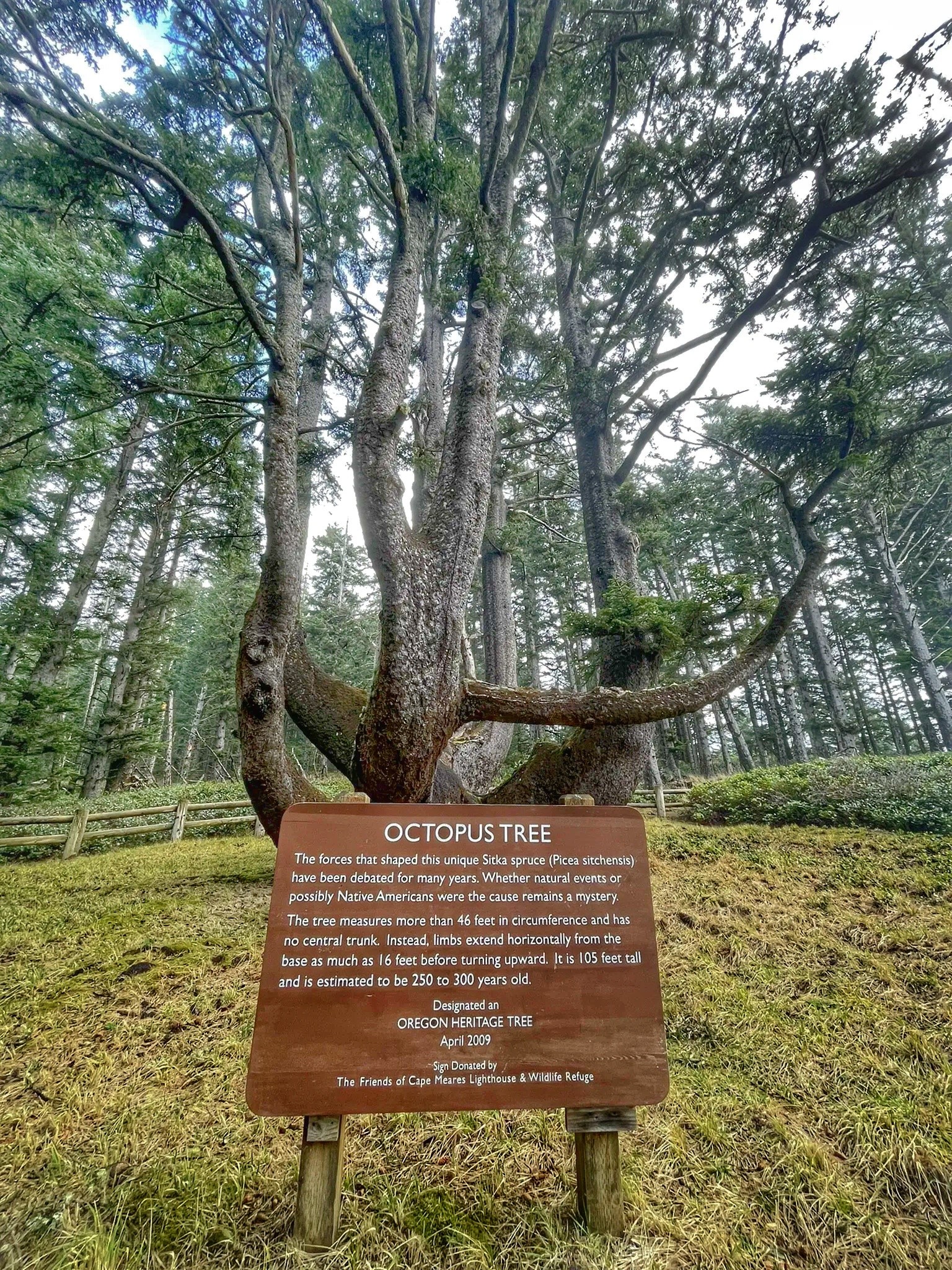
At first, it doesn’t look like a tree at all. There’s no single trunk rising upward like you expect. Instead, massive limbs stretch outward from a wide, grounded base, crawling horizontally before lifting skyward again. The branches are thick — impossibly thick — like entire trees fused together at the roots.
It truly looks like something alive in a way trees rarely do, as if it could move if it chose to.
I stopped without realizing it, my steps slowing until I was standing completely still. Other visitors did the same. No one spoke. There was an unspoken agreement that this was not a place for noise or haste.
Walking Around a Living Sculpture
I circled the Octopus Tree slowly, taking it in from every angle. Each perspective revealed something different: one side where the limbs stretched low and wide like arms embracing the ground, another where they surged upward in tall, cathedral-like columns.
The bark is deeply textured, rough and ridged, carrying centuries of wind, rain, and salt spray in every groove. Moss clings to shaded sections. Lichen freckles the surface in pale greens and silvers. This isn’t a pristine, manicured landmark — it’s wild, weathered, and unapologetically ancient.
I placed my hand against the bark and felt how cool it was, even on a mild day. It made time feel tangible, like I was touching something far older than myself in a way I rarely get to.
The Shape That Sparks Stories
You can’t stand beneath the Octopus Tree without wondering why it looks this way.
Some say coastal winds trained it, storms bending young limbs outward over decades. Others believe the explanation runs much deeper — that Indigenous peoples intentionally shaped the tree when it was young, guiding its branches into this wide, ceremonial form.
As I stood there, that second explanation felt right in my bones.
The idea that this tree may once have held burial canoes or served as a sacred gathering place adds weight to the space around it. Suddenly, the quiet makes sense. Suddenly, the urge to tread lightly and speak softly feels instinctive rather than forced.
I lost track of how long I stayed.
Minutes stretch beneath the Octopus Tree. The wind sighs through the branches above, shifting shadows across the forest floor. The ocean’s distant rhythm becomes hypnotic. Every so often, sunlight breaks through the canopy, illuminating one massive limb at a time, as if spotlighting the tree’s many “arms.”
I watched people arrive with phones raised, then slowly lower them. I watched kids run ahead, then stop short, their energy dimming into awe. I watched couples sit quietly on nearby benches, saying nothing at all.
An Anchor in the Landscape
What struck me most was how rooted the Octopus Tree is, despite its sprawling form. Its base is wide and grounded, gripping the earth like it has no intention of ever letting go. After centuries of coastal storms, earthquakes, and changing human landscapes, it’s still here.
It has outlived settlements, industries, roads, and entire ways of life.
That realization stayed with me long after I stepped away.
So many places along the Oregon Coast are breathtaking, but they often come with movement — waves crashing, tides shifting, fog rolling in and out. The Octopus Tree is different. It is stillness made visible.
Standing there reminded me that not every natural wonder demands adrenaline or sweeping views. Some ask for quiet. Some ask for patience. Some ask you to slow your breath and remember that the land has stories far older than our own.
When I finally turned back toward the trail, I glanced over my shoulder more than once. The tree looked different each time — darker in shadow, lighter as the sun shifted, broader than memory could hold.
Driving away, the image lingered in my mind: a living being shaped by time, wind, culture, and intention. A reminder that the Oregon Coast isn’t just dramatic cliffs and roaring surf — it’s also subtle, sacred, and deeply human in its history.
The Octopus Tree is something you experience.