“Known Only to God”: The Sailors’ Grave of Seaside, Oregon
On a quiet stretch of the northern Oregon Coast, where the Pacific rolls in with a steady rhythm and fog drapes itself over the cliffs, there is a small, easily missed place that carries more weight than most landmarks twice its size. Just east of Seaside’s Cove, near the base of Tillamook Head, sits what locals have long called the Sailors’ Grave. It is not grand. It does not command attention. Yet it holds one of the most haunting and enduring stories on the coast.
This is not just a grave. It is a reminder of how unforgiving the ocean once was, and still can be. It is a memorial to people whose names were never recorded, whose stories were swallowed by saltwater and time, and whose final resting place lies just beyond the reach of the tides that claimed them.
A Quiet Place Above the Surf
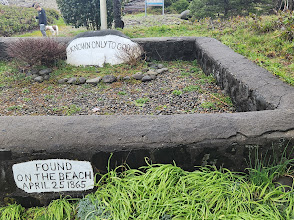
Today, the Sailors’ Grave appears as a small, square plot enclosed by a low stone wall. Inside stands a simple marker, often accompanied by a flag fluttering in the coastal breeze. The inscription is brief and devastating in its simplicity:
“Known Only to God”
Found on the Beach April 25, 1865
There is no name. No ship listed. No origin. Only the date and the acknowledgment that whoever lies here passed beyond the reach of human record. Visitors often walk past without noticing it at all. Others stop suddenly, drawn in by the gravity of what is not said.
In a town now known for boardwalks, family vacations, and summer sunsets, the Sailors’ Grave feels like a doorway into a far rougher era.
The Coast Before Comfort
To understand you have to imagine Seaside as it once was. In the mid-1800s, this was not a resort town. It was a remote, dangerous edge of the continent. There were no lighthouses nearby, no modern navigation aids, no reliable charts of shifting sandbars and hidden rocks. Ships approaching the Oregon Coast faced towering swells, sudden storms, and currents powerful enough to tear vessels apart.
This stretch of ocean would later earn the grim nickname “The Graveyard of the Pacific.” Shipwrecks were common. Survivors were not guaranteed. Bodies washing ashore were an unfortunate reality of coastal life.
When someone died at sea and their remains reached land, there were rarely records, and often no way to identify them. Burial was an act of necessity and respect, not ceremony.
The Story Most Often Told
The most enduring local story dates to April of 1865. According to oral histories and early written accounts, a ship anchored offshore sent several sailors toward land to gather fresh water. A local settler, often identified as John Hobson, encountered them on the beach near the Cove.
As the day wore on, the weather began to change. Winds strengthened. Waves grew steeper and more chaotic. Hobson, concerned for the sailors’ safety, reportedly built a large fire on the beach to guide them back to shore or help them orient themselves in the storm.
It wasn’t enough.
By morning, bodies had washed ashore. How many remains uncertain. Some accounts say three sailors were lost. Others suggest fewer bodies were recovered. Hobson buried them above the high tide line, marking the location as best he could.
Over time, storms erased markers. Sand shifted. Memory blurred. What remained was the knowledge that sailors had died here, unnamed, their fate sealed by the Pacific.
Alternative Theories and Lingering Questions
As with many coastal legends, the Sailors’ Grave has more than one possible origin. Another theory links the burial to the wreck of the barque Industry, which was lost in early 1865 while attempting to cross the Columbia River Bar. That crossing was infamous even among experienced captains, and the Industry’s wreck scattered lives and debris along the coast.
Some historians believe one or more crew members, possibly even the captain, washed ashore near Seaside and were buried here. Later correspondence from the late 1800s references a grave believed to belong to a shipwreck victim from that era, though details are frustratingly vague.
There is also the possibility that the Sailors’ Grave does not mark a single incident at all, but rather became a symbolic marker for multiple unknown burials over time. In an age before formal cemeteries and records, it was not uncommon for coastal graves to be reused or reinterpreted as memory shifted.
What is certain is that no definitive proof exists. The ocean took the answers with it.
Preservation Through Community Care
The grave as it appears today was not formalized until the 1930s, when local architect Al Hansen helped construct the stone enclosure to protect the site. Without that effort, it is likely the location would have been lost entirely to erosion, development, or simple forgetting.
Since then, residents and history advocates have quietly taken responsibility for its upkeep. Flags are replaced. Weeds are cleared. Occasionally, flowers appear. There is no official caretaker, just a shared understanding that this place matters.
It has survived not because it is flashy or profitable, but because people cared enough to remember.
Why the Sailors’ Grave Still Matters
The Sailors’ Grave stands as a counterpoint to the modern coast. It reminds visitors that beneath the beauty, the Oregon Coast has always demanded respect. Long before vacation rentals and scenic overlooks, this shoreline was a test of endurance and luck.
It also represents something deeper: the countless lives that history never recorded. Sailors without names. Workers far from home. Men whose families may have waited for news that never came.
The phrase “Known Only to God” is not poetic embellishment. It is a statement of reality. These sailors’ identities are lost forever, but their existence is not.
Standing There Today
If you visit the Sailors’ Grave, you might hear the waves crashing against the rocks below. You might feel the wind funneling around Tillamook Head. It doesn’t feel dramatic. It feels quiet. Heavy. Honest.
And that may be exactly the point.
In a place shaped by motion and change, the Sailors’ Grave endures as something still. A pause in the noise of the coast. A reminder that every shoreline carries stories beneath its surface, whether we know their names or not.
The ocean remembers, even when history does not.