The Neskowin Ghost Forest: Oregon Coast’s Ancient Whisper Beneath the Waves
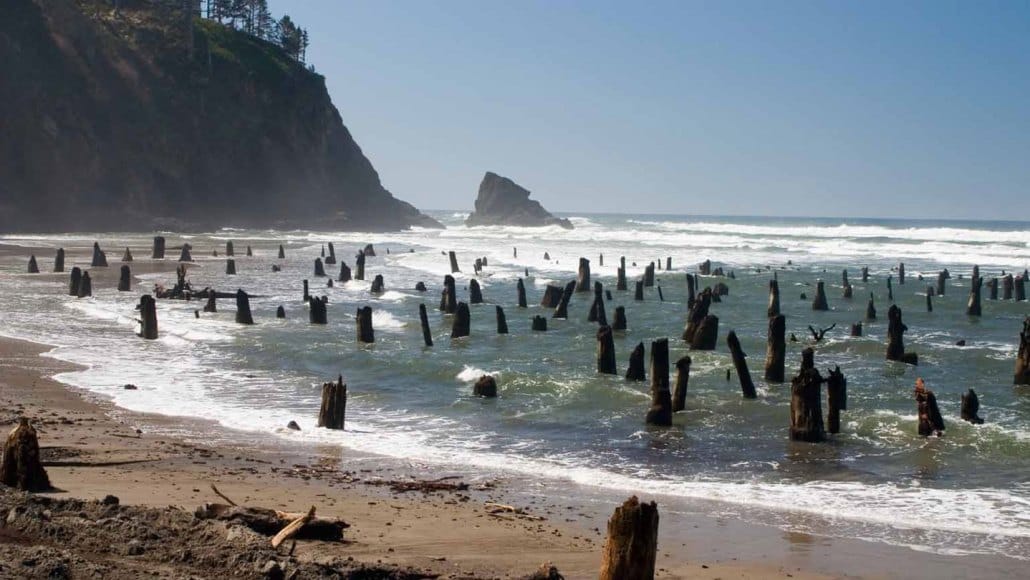
Stretching along a stretch of sandy shoreline near Neskowin Beach State Recreation Site on the Oregon Coast lies one of the region’s most mysterious and compelling natural phenomena: the Neskowin Ghost Forest. At first glance, this eerie collection of ancient tree stumps — jutting from the sand and surf like the petrified remnants of a forgotten woodland…. But these stumps are very real — and very old.
A Forest Frozen in Time
Beneath the rhythmic tides of the Pacific Ocean lie the petrified remains of an ancient Sitka spruce forest that thrived on what is now the Tillamook County coast roughly 2,000 years ago. Carbon dating of stump material places the forest’s burial around that time, and scientists estimate that these giant trees once reached 150–200 feet tall, towering over a lush temperate rainforest that stretched to the sea.
Unlike typical fossilized wood, the stumps at Neskowin are preserved in their original form — thanks to the unique conditions of coastal burial. When sand and sediment rapidly enveloped the trees, the lack of oxygen slowed decomposition, allowing their bases to remain intact for millennia.
How the Forest Met the Sea
Exactly how the forest came to be buried remains the subject of scientific debate and local lore. Some geological interpretations point to a major seismic event — a massive earthquake along the Cascadia Subduction Zone — as the catalyst that caused the land to suddenly subside. This dramatic sinking would have placed the forest floor beneath sea level, allowing tidal waters to inundate the trees and seal their fate under layers of sand and mud. Tsunami waves may have further contributed to the burial process.
Other research suggests that gradual coastal processes, such as dune migration and episodic sediment deposition, could also explain how the forest was slowly engulfed by sand over decades or centuries rather than by a single cataclysm. Regardless of the precise mechanism, the result is the same: an ancient forest locked in time beneath a shifting shoreline.
Rediscovery and Modern Visibility
For generations, local residents whispered about buried stumps that occasionally peeked through the sand after powerful storms. But it wasn’t until the winter storms of 1997–1998 — among the most intense in recent memory — that the sands were dramatically scoured, revealing dozens of these ancient stumps along the beach. Since then, roughly 100 stumps have become a semi-regular feature of the Neskowin coastline.
However, the ghost forest is not always visible. The stumps sit in the intertidal zone, and the best time to see them is during low tide, especially in the winter months or during unusually low tidal cycles. At high tide, many stumps remain submerged beneath the surf.
An Eerie Coastal Landscape
Walking among the stumps at low tide is an experience that blends natural history with haunting beauty. These weathered remnants — some encrusted with barnacles, mussels, and marine life — rise like silent sentinels against the backdrop of rolling waves and open sky. Small tidepools form in crevices, home to crabs, sea stars, and other shoreline creatures, adding another layer of life to this ancient scene.
The area near the ghost forest is also home to Proposal Rock, a scenic sea stack that adds to the dramatic coastal vista and can be reached on foot at low tide from Neskowin Beach.
Cultural and Scientific Significance
The Neskowin Ghost Forest captures the imagination not only of visitors and photographers but also of scientists studying coastal geology and paleoenvironments. These stumps offer a rare glimpse into the past — a snapshot of an ecosystem that existed long before European settlement and modern geology.
At the same time, the ghost forest serves as a subtle reminder of the dynamic nature of the Pacific Northwest’s coastline, shaped by seismic forces, ocean currents, and shifting sands. It evokes both wonder and respect for the deep time that has sculpted this remarkable region.
Visiting Today
For travelers drawn to the unusual and ancient, the Neskowin Ghost Forest is a must-see stop along Oregon’s Highway 101. Visitors should check local tide charts to time their exploration for low tide, wear sturdy shoes for walking along slippery sand and rocks, and always keep an eye on ocean conditions — sneaker waves can be dangerous.
The Neskowin Ghost Forest offers a hauntingly beautiful bridge to the past — a forest frozen in time, whispering stories from beneath the waves.